Use the framed size when measuring your wall space.
SOLD OUT. This edition was super popular and is now completely sold out. Be the first to hear about new artworks and get early access — sign up now and follow the artist.
Secure this price for 48 hours
Secure this price for 48 hours
Tabita Pietsch has developed a photographic practice defined by rigorous reduction. Her works focus on architecture at the moment it becomes visual order: façades, doors, and planes of color are isolated, framed frontally, and distilled…
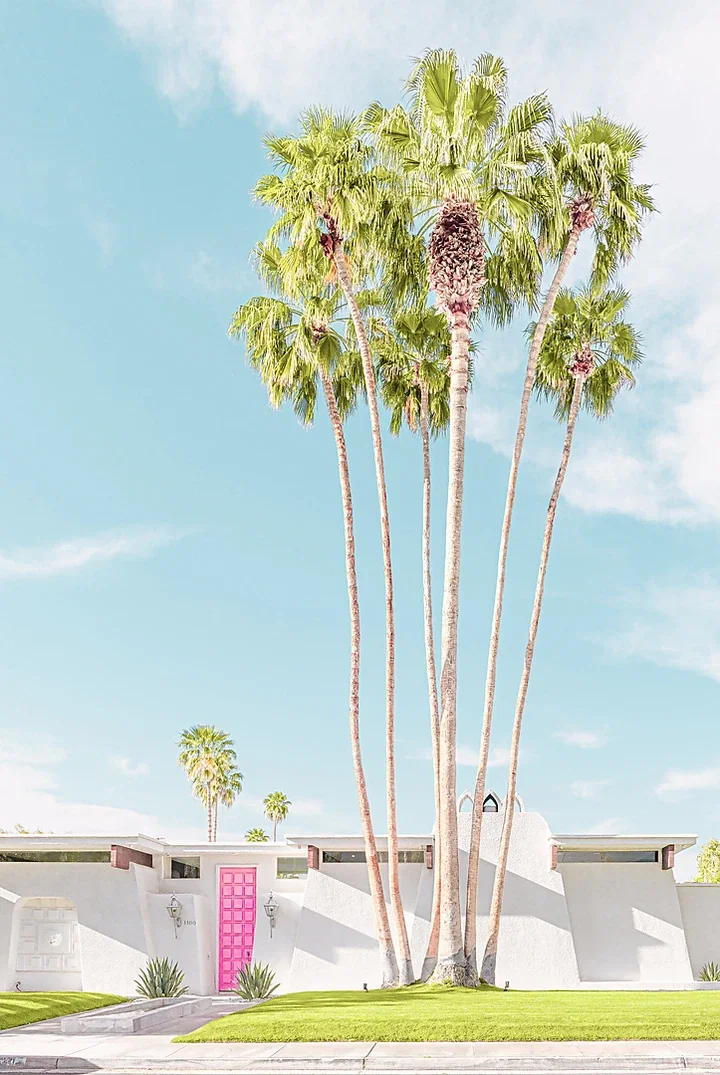
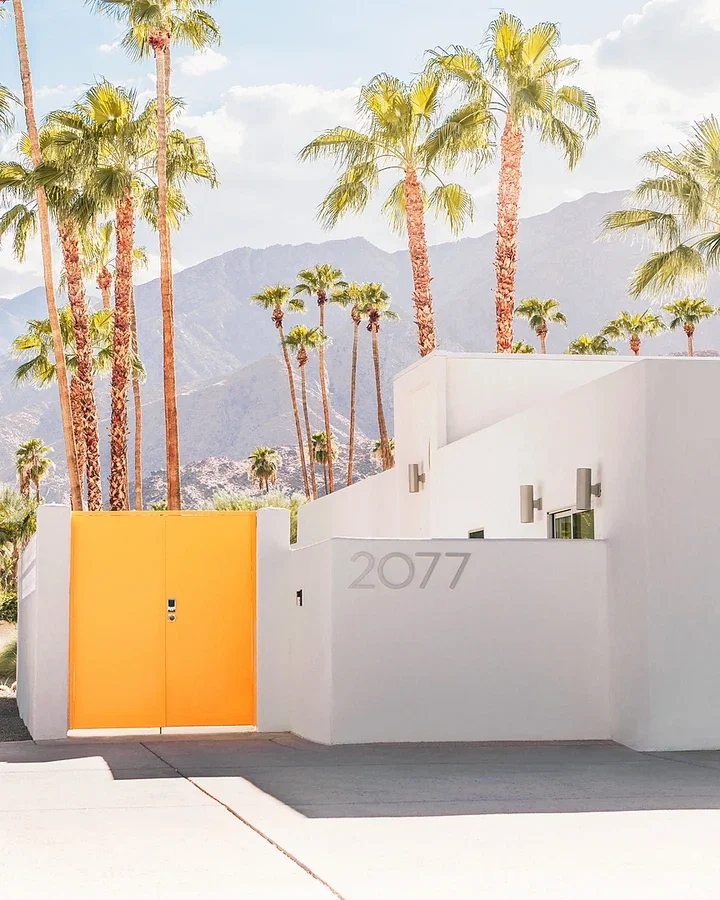
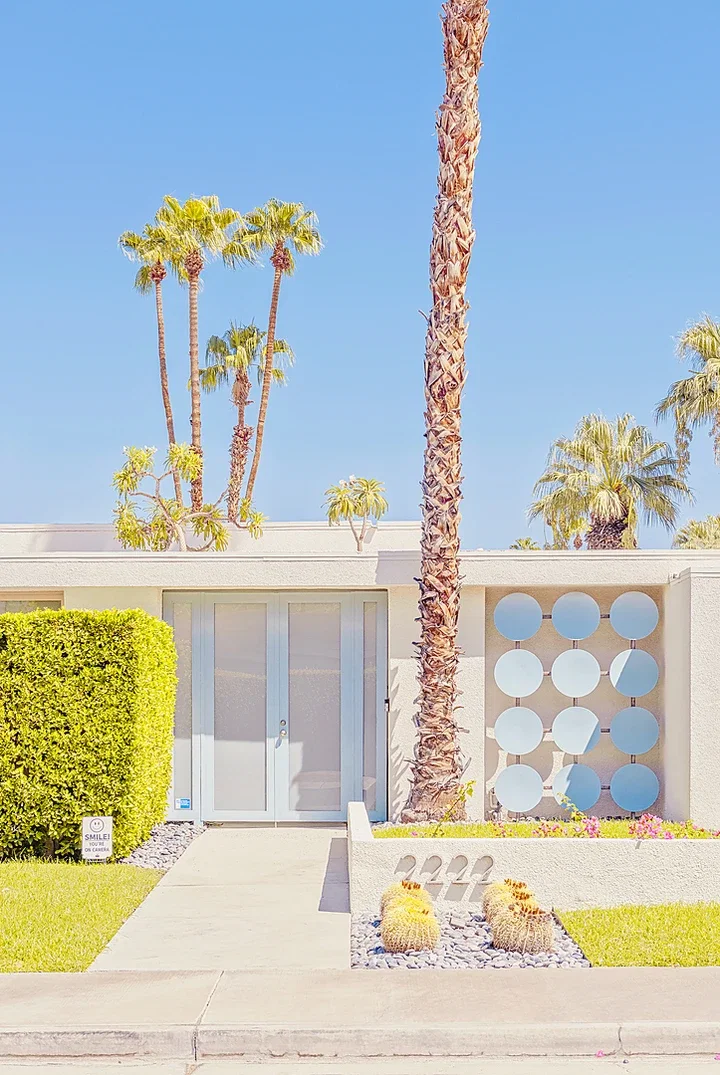
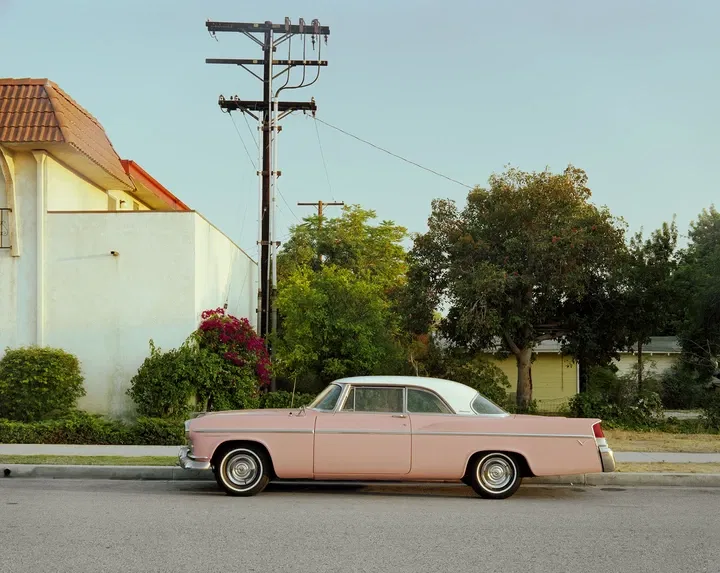
In her series “Modern Paradises,” Tabita Pietsch condenses architecture into a clear visual order. Façades, doors and fields of color are isolated frontally, reduced and precisely composed. She transforms the architecture of Palm Springs in particular into a visual language of lines, light and color. Soft, almost shadowless brightness allows spatial depth to recede; what remains is the surface as a stage for the essential. Pietsch deliberately excludes people and movement — not out of emptiness, but out of consistency. Her images do not narrate; they arrange. Between documented architecture and composed fine art, she creates a photographic language that gains expression through omission.
BACKGROUND INFORMATION
Tabita Pietsch has developed a photographic practice defined by rigorous reduction. Her works focus on architecture at the moment it becomes visual order: façades, doors, and planes of color are isolated, framed frontally, and distilled into precise compositions.
Born in Bucharest and now based in Nuremberg, she has established herself internationally through this distinctly controlled visual language. Her works have received numerous awards and have been shown in international exhibitions from Los Angeles to Paris — a resonance also reflected in features in The Guardian, Vogue, Saatchi Art, and the British Journal of Photography.
At the center of her work is, time and again, the architecture of Palm Springs. Pietsch does not approach these places only once; she returns to them repeatedly, at different times of day and under changing light conditions. The result is not a spontaneous image, but a deliberately developed one: architecture is observed, refined, and ultimately translated into a clear visual form.
That form is built from only a few, carefully placed elements. Frontal perspectives, symmetrical arrangements, and a strict division of surfaces define the composition. Color takes on the central role. Pastel tones, sometimes with an almost artificial quality, stand alongside saturated planes of color; doors and façade elements become autonomous compositional accents. Color does not describe here — it structures.
Light follows the same logic. It is soft, almost shadowless, and often slightly overexposed. As a result, the motifs lose spatial depth and emerge as flat surfaces. Architecture no longer appears as built space, but as a visual construction — clear, reduced, and controlled.
From this reduction, the conceptual dimension of her work emerges. People, movement, and disorder are deliberately excluded. The images do not tell concrete stories; they do not prescribe a narrative. Instead, they direct attention to what remains when all storytelling recedes: form, color, relation.
This is precisely how her motifs become carriers of a cultural image. Palm Springs, Mid-Century architecture, clean lines, and intense colors stand not only for places, but for a visual idea of modernity, calm, and prosperity. Pietsch draws on this imagery and translates it into a precise, contemporary form.
Her photographs do not derive their power from staging, but from decision. Clarity emerges through omission. Precision emerges through repetition. And from that precision arises a visual language that positions itself unmistakably between documented architecture and consistently composed fine art.
VITA
Tabita Pietsch is an internationally award-winning fine art photographer based in Nuremberg. Born in Bucharest, she was initially a professional tennis player, competing for Dinamo Bucharest, winning the national championship with her team, and representing Romania on the national team. She discovered photography later in life in a personal way, when she first picked up her husband’s camera. Since 2010, she has dedicated herself to fine art photography and has since established an international presence. Her work has been featured in The Guardian, VOGUE, Saatchi Art, the British Journal of Photography, The Cut, Hyperallergic, Daily Mail, and Aesthetica Magazine, and has been exhibited in cities including Los Angeles, Arles, New York, Barcelona, Paris, Florence, Sydney, Rome, and London.
INTERVIEW
Picasso once said, “Art is not made, it is found.” Where do you find your art?
My husband and I love to travel. When I discover places that move me, it makes me very happy. I keep returning there with my camera, capturing them at different times of the day. Over the years, this has created wonderful memories, often intertwined with unique stories and adventures.
From idea to execution: how do you approach your work?
It varies. When I photograph people, everything is already in my mind. It is all carefully thought out and planned—from the location, outfit, and props to the pose. When I photograph places or landscapes, I like to immerse myself in their special beauty and magic and capture it with my camera.
What is your favorite book?
One Hundred Years of Solitude.
How did you get into art?
Through my husband—at the time still my boyfriend. He let me try out his new camera, and that was it—I was hooked.
Who are the people around you that influence you?
My family—especially my son and my husband—play a significant role in my life. Beyond that, I greatly value the support and inspiration of my dedicated friends.
Imagine you had a time machine. Where would you travel?
California in the 1960s really appeals to me.
Aside from art, what are you most passionate about?
Sports (I love tennis and padel)
Traveling
Spending time in nature
Being with my loved ones
What are you currently working on?
At the moment, I’m working on various projects and ideas. I’m also planning to organize more events in my studio to bring together artists and art enthusiasts.
LUMAS ART NEWS
Exclusive offers
Inspiring new releases
Personal invitations to Art Events
LUMAS protects your data. See our Privacy Policy for details.
ALMOST DONE ...
1. Open the confirmation mail.
2. Click on the confirmation link.
3. Your wishlist registration was successful!
4. Your wishlist has been saved!
We look forward to welcoming you soon to the world of LUMAS.
DIGITAL PREVIEW
SCAN THE QR CODE! (Safari IPHONE ONLY)
PREVIEW ON YOUR WALL
SCAN THE QR CODE! (Safari IPHONE ONLY)
90% of our customers order mounting or framing for a perfect gallery look.
Fully protected by our 30 day return policy.
Ready to Hang.
Elevates the artwork to true gallery quality.
Continue without mounting or framing?
* Rolled prints are final sale and cannot be returned or retrofitted with our frames





 About Tabita PietschTabita Pietsch has developed a photographic practice defined by rigorous reduction. Her works focus on architecture at the moment it becomes visual order: façades, doors, and planes of color are isolated, framed frontally, and distilled…
